
Who Was Simon Bolivar The Liberator of South America?
- Latin London

- Aug 21, 2025
- 3 min read
Simón Bolívar: The Liberator of South America
Simón José Antonio de la Santísima Trinidad Bolívar Palacios, better known simply as Simón Bolívar, was born on July 24, 1783, in Caracas, in what was then the Captaincy General of Venezuela, part of the Spanish Empire. He came from a wealthy Creole family of Basque origin. His parents died when he was very young—his father when Bolívar was only two, and his mother when he was nine. This left him in the care of relatives and tutors, who gave him a privileged education but also exposed him to a sense of independence and responsibility early in life.
One of the most influential figures in his childhood was his tutor, Simón Rodríguez, who introduced him to Enlightenment thinkers such as Rousseau, Locke, and Montesquieu. These ideas about liberty, republicanism, and the rights of man deeply shaped Bolívar’s worldview.
As a teenager, Bolívar was sent to Europe, where he continued his studies and became acquainted with revolutionary thought firsthand. While living in Spain, he married María Teresa del Toro, but she tragically died of yellow fever within a year, leaving Bolívar devastated. After her death, he vowed never to remarry and instead devoted himself to public life.
In 1804, Bolívar traveled to France and witnessed the coronation of Napoleon Bonaparte as Emperor. Although he admired Napoleon’s military genius, he also recognized the dangers of tyranny. Standing on Monte Sacro in Rome in 1805, Bolívar swore an oath that he would not rest until he had liberated his homeland from Spanish rule.
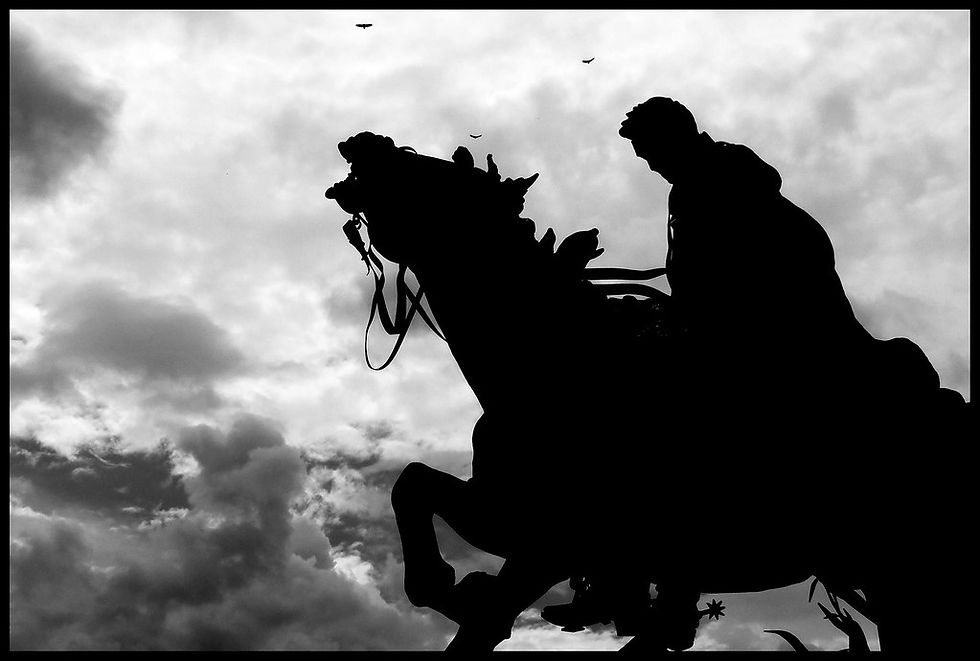
The Fight for Independence
The opportunity came in 1810, when revolts broke out in Venezuela following Napoleon’s invasion of Spain. Bolívar quickly rose as a leader in the independence movement. His first campaigns were marked by both victories and crushing defeats, including the loss of the First Venezuelan Republic. Forced into exile, he fled to New Granada (modern-day Colombia), where he regrouped and wrote the “Cartagena Manifesto”, outlining his vision for how independence could be achieved.
Bolívar’s persistence became legendary. Over the following decade, he led daring campaigns across South America. One of his most remarkable feats was the crossing of the Andes in 1819, where his army marched through freezing mountains to surprise Spanish forces in what is now Colombia. The victory at the Battle of Boyacá secured independence for New Granada.
By the early 1820s, Bolívar had liberated vast territories, including Venezuela, Colombia, Ecuador, and later Peru. In 1825, the newly independent nation of Bolivia was named in his honor

Dreams of Unity
Bolívar was not only a brilliant general but also a statesman with a vision. He dreamed of a united Latin America, free from colonial rule and strong enough to resist future imperial domination. To this end, he helped establish Gran Colombia, a federation of Venezuela, Colombia, Ecuador, and Panama, with himself as president.
However, Bolívar’s dream of unity quickly ran into difficulties. Deep regional divisions, rivalries among leaders, and resistance to central authority led to the fragmentation of Gran Colombia. Bolívar, increasingly disillusioned, remarked bitterly, “Those who have served the revolution have ploughed the sea.”
Final Years and Death
By 1830, Bolívar had resigned from the presidency and withdrawn from public life. His health was failing—he suffered from tuberculosis—and his political enemies grew more powerful. On December 17, 1830, at the age of 47, he died in Santa Marta, in present-day Colombia, far from his native Caracas and surrounded not by triumph but by disillusionment.

Legacy
Despite his troubled final years, Simón Bolívar’s legacy is immense. He is remembered as the “George Washington of South America”, though his impact stretched across multiple nations rather than one. Statues, cities, and even an entire country—Bolivia—bear his name. For millions of Latin Americans, Bolívar symbolizes the struggle for independence, freedom, and national identity.
Today, Bolívar remains a towering figure in Latin American history—admired not only as a brilliant military commander but also as a visionary who dared to imagine a united, sovereign continent.


Comments